


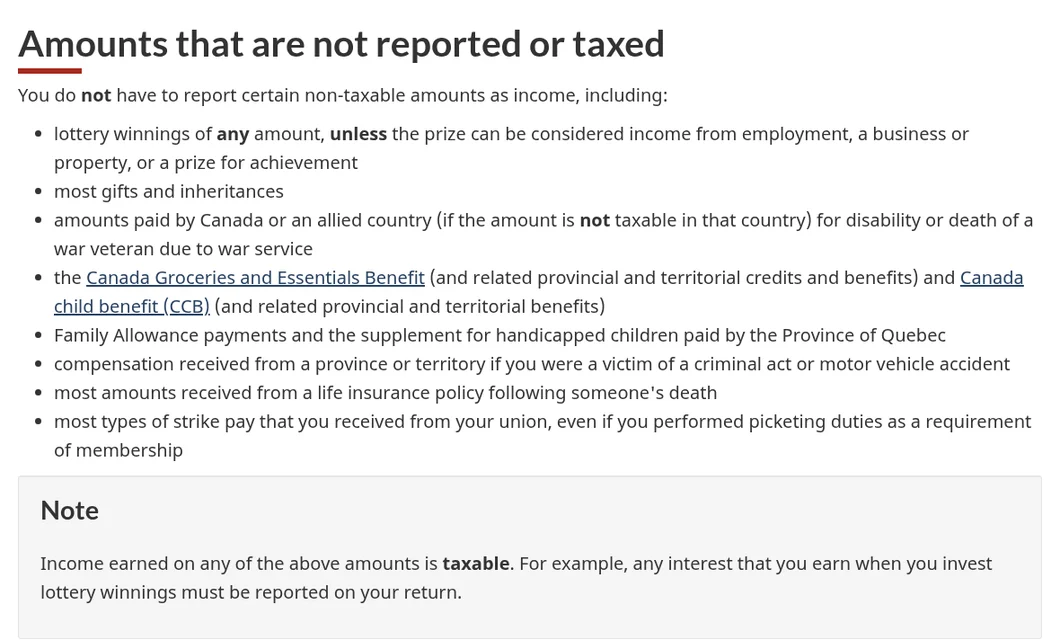
No: for recreational players, gambling winnings are not taxable in Canada. The Canada Revenue Agency lists lottery winnings of any amount among the amounts you do not report or pay tax on, and treats casino, poker and sports betting wins the same way, as windfalls, not income.
A jackpot paid by a licensed Ontario casino is yours in full and stays off your tax return. Three things change that. Gambling carried on as a business is taxed on its net profit, and in 2025 the Federal Court of Appeal confirmed that skilled poker players can cross that line. Interest or investment income earned on winnings is taxable like any other income. And a win at a casino in the United States is taxed there, with 30% held back before you are paid.
Ontario adds nothing of its own. The provincial tax on Form ON428 is worked out from the same taxable income as the federal return, so a win that is not income for the CRA is not taxed by Ontario either. The $10,000 figure that worries many players is a casino’s report to FINTRAC, Canada’s financial intelligence unit, not a tax. Only operators on the iGaming Ontario register are licensed to serve players in the province, and our guide to iGaming Ontario and legal gambling explains how to check one.
On this page
Which gambling winnings are taxed in Canada
What decides it is the kind of money and how you came by it, never the size of the win. This is how the CRA’s rules apply to the winnings an Ontario player is most likely to have:
| Winnings | Taxed in Canada? | Why |
|---|---|---|
| Online casino wins at a licensed Ontario site: slots, table games, live dealer | No | A windfall for a recreational player |
| Lottery prizes, including OLG draws and instant tickets | No | The CRA excludes lottery winnings of any amount |
| Sports betting and poker played as a pastime | No | The same windfall rule; playing often does not by itself make it a business |
| Gambling carried on as a business | Yes, on net profit | Business income, and a losing year becomes a deductible business loss |
| Interest, dividends or gains earned on winnings | Yes | Income from property, reported each year it is earned |
| Wins at a casino in the United States | Taxed in the US | 30% withheld from most wins; blackjack, baccarat, craps, roulette and big-6 wheel are exempt |
| A prize linked to your job or your business | Yes | Employment or business income, or a prize for achievement |
For most players only the first three rows ever apply. A recreational win is not income whether it is $50 or $5 million, and recreational losses work the same way in reverse: with no source of income there is nothing to set them against, and only a gambling business can claim a loss.
Why a casino win counts as a windfall
The CRA’s Income Tax Folio S3-F9-C1 sets out the signs of a windfall: no enforceable claim to the payment, no organized effort to obtain it, no expectation that it will recur, and no link to a service you provided. A casino win fits every one of them. Paragraph 40(2)(f) of the Income Tax Act adds that no capital gain or loss arises from the chance to win a lottery prize or a pool bet, so a winning ticket is not treated as an asset that rose in value either.
Lottery pools and sharing a win
A group that wins together is treated like a single winner: the Folio says each member of a lottery syndicate has the same tax result, so an office pool’s prize is tax-free in every member’s hands. Passing part of a win to family is a gift, and the CRA lists most gifts among the amounts that are not taxed. What the money earns after that is a different matter, as the section on interest explains.
When gambling becomes taxable business income
Rarely, and never because of the amount. The Folio quotes the Tax Court of Canada’s view that gambling, “even regular, frequent and systematic gambling”, is not generally regarded as a commercial activity except in very exceptional circumstances. The exceptions involve skill, inside information or organization that reduces the role of chance: the Folio’s own example is a pool player who stayed sober and challenged drunk players for money.
Whether someone is running a gambling business is a question of fact, judged on their whole course of conduct rather than chosen year by year. The CRA weighs four factors, none of them decisive on its own:
- Organization: how structured and systematic the activity is.
- An edge: special knowledge or inside information that reduces the element of chance.
- Intention: playing for pleasure, or playing to earn a living.
- Extent: the number and frequency of bets.
If the answer is yes, the whole year is taxed as business income at your marginal rate, and a losing year produces a business loss that can be deducted.
The 2025 poker ruling
In Fournier-Giguère v. Canada, 2025 FCA 112, decided on June 10, 2025, the Federal Court of Appeal dismissed the appeals of three Quebec poker players whose net poker earnings the Tax Court had included in income as business income. The court accepted that poker combines skill and chance, rejected the argument that it is a betting game sheltered by paragraph 40(2)(f), and looked at how the three played: up to 25 hours a week, coaching and training sites, and software that tracked opponents’ habits and their own results. The Supreme Court of Canada dismissed their applications for leave to appeal on June 4, 2026, so the ruling stands.
The contrast with an earlier case is the useful part. In Duhamel v. The Queen, 2022 TCC 66, the Tax Court found that the net poker earnings of world champion Jonathan Duhamel were not income for 2010 to 2012. The Court of Appeal noted that the test was the same in both cases and the facts were not. One big win does not make a professional; a system for winning again and again can.
What this means for casino players
For slots, roulette, blackjack and live dealer games at an Ontario casino, the question almost never arises. These are house-edge games, where no amount of organization removes the casino’s margin, which is why the exceptional cases all involve skill against other people or an informational edge. Poker against other players, and sports betting built on models and volume, are where the line can be crossed. Our guide to online poker in Ontario covers where those games are played.
Interest and income earned on your winnings
The win is tax-free, but what it earns afterwards is not. The CRA’s own example is interest on invested lottery winnings, which must be reported on your return, and the same applies to dividends, rent or capital gains from whatever you buy with the money.
Put a $100,000 jackpot into a savings account paying 3%, and the $3,000 of interest it earns in a year is taxable income, even though the $100,000 never was. Money held in a tax-free savings account, within your contribution room, is the exception, because the CRA treats most amounts received from a TFSA as non-taxable.
Prizes that are not cash
A lottery prize of a car, a house or a trip is tax-free when you win it. Under subsection 52(4), you are treated as having acquired it at its fair market value on that day, so if you later sell it for more, only the increase after the win can be a taxable gain.
Winning $10,000 or more: the FINTRAC report
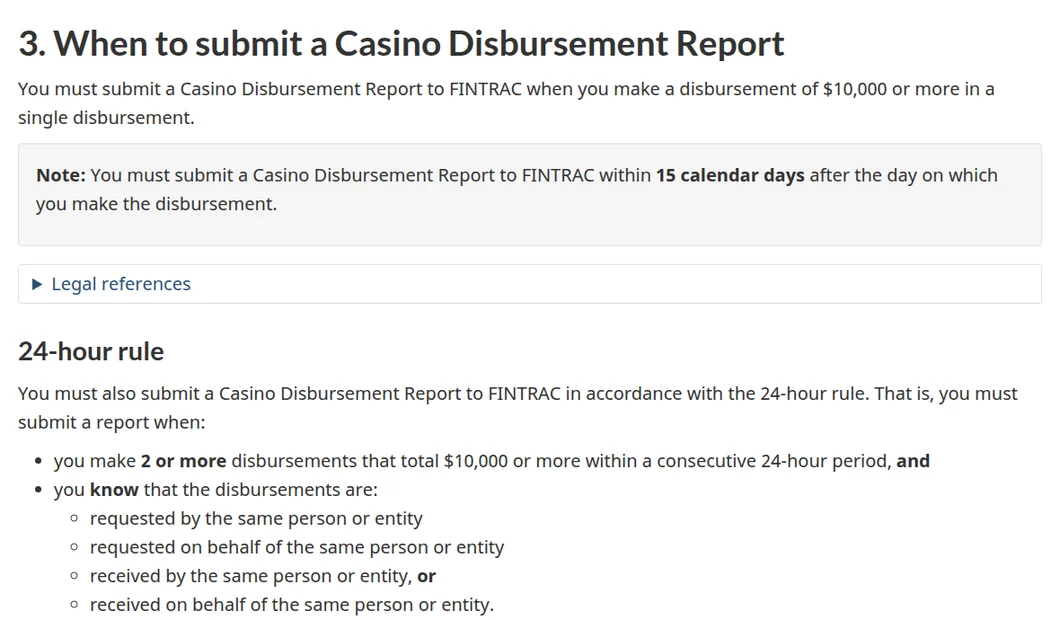
A payout of $10,000 or more triggers a report, but not a tax. Under the Proceeds of Crime (Money Laundering) and Terrorist Financing Act, casinos are reporting entities, including lottery schemes accessible to the public online, and FINTRAC requires a Casino Disbursement Report whenever a casino pays out $10,000 or more in a single disbursement.
A 24-hour rule catches split payouts: two or more disbursements to the same person that add up to $10,000 within 24 consecutive hours are reported as well, and the report is due within 15 calendar days. The casino must also verify the identity of the person who receives the money. Nothing is deducted along the way, and you receive the full amount.
What a large withdrawal looks like in practice
At a licensed Ontario casino, a large withdrawal means your account has to be fully verified before the money leaves, and the operator may ask for documents it did not need for smaller amounts. Clearing verification before you request a big payout is the quickest way to receive it. Our guide to the fastest casino withdrawals in Ontario compares processing times at all 70 licensed casinos we review.
Gambling winnings from the United States
This is the one place where Canadians regularly pay tax on gambling. The US taxes nonresidents on gambling won in the United States, and IRS Publication 515 sets withholding at 30% of the gross win, reported to the winner on Form 1042-S. Five games are exempt for nonresident visitors: blackjack, baccarat, craps, roulette and big-6 wheel. A slot jackpot, a keno ticket or a poker tournament prize is not.
| Win at a US casino | Withheld at payout | What a Canadian can recover |
|---|---|---|
| Slot or video poker jackpot | 30% of the gross win | Tax on the part offset by US gambling losses, through Form 1040-NR |
| Keno, bingo or a poker tournament prize | 30% of the gross win | The same treaty relief for US gambling losses |
| Lottery or raffle prize | 30% of the gross win | The same treaty relief for US gambling losses |
| Blackjack, baccarat, craps, roulette, big-6 wheel | Nothing | Nothing to recover: no US tax applies |
The Canada–US tax treaty is what makes the money recoverable. As IRS Publication 597 puts it, Canadian residents may deduct gambling losses in the US against gambling winnings in the US in the same manner as a US resident. On Form 1040-NR, winnings go on line 10a, losses on line 10b and the net on line 10c; if the losses are larger, the net is zero, because a net gambling loss is not deductible.
Getting withheld tax back
Recovering it means filing a 1040-NR for the year of the win, attaching the Form 1042-S, and backing up the losses with records such as the casino’s win-loss statement. The return needs a US taxpayer number; a Canadian without a Social Security number applies for an ITIN on Form W-7. Since the win is not income in Canada, the Canadian return has no place for it, and the US return is the only route back.
None of this touches Ontario’s own market. Licensed US online casinos accept only players located inside their state, and a licensed Ontario site pays out with nothing withheld.
Lottery prizes and OLG
The CRA excludes lottery winnings of any amount from income, so an OLG jackpot, a scratch ticket or a charity lottery prize is not reported on your return. The Folio makes three exceptions:
- A prize that is really income from employment, a business or property, such as a draw an employer runs for staff as a reward for performance.
- A prize for achievement under paragraph 56(1)(n), which is income rather than luck.
- Lottery ticket retailers, who must include the prize commissions they receive from a provincial lottery corporation in their income.
For a player buying tickets, none of the three applies, and the prize keeps its tax-free status however large it is.
Records worth keeping after a big win
Tax-free does not mean undocumented. A large deposit into a bank account can raise questions later, from the CRA, a bank’s compliance team or a mortgage lender asking where a down payment came from, and the casino’s records are what answer them:
- Your transaction history, downloaded from the casino account with dates, deposits and withdrawals, before you close the account.
- The withdrawal confirmation and the matching credit on your bank statement.
- Messages with the casino about a large payout, including any verification request.
- For US wins, every Form 1042-S and the casino’s win-loss statement for the year.
- If your play could look like a business, a log of sessions, stakes, results and hours.
Keep them for as long as the money matters. The CRA’s general rule for tax records is six years from the end of the tax year they relate to.
What comes off an Ontario casino withdrawal
No tax. Canada does not withhold tax on gambling winnings, so a licensed Ontario casino pays out the full balance you ask for. What can reduce a withdrawal is the operator’s own cashier rules: a fee after a set number of free withdrawals, a charge on deposits that were never played, or a currency conversion by your bank or wallet.
Those costs differ from one casino and one method to the next. Our guides to Interac casinos, PayPal casinos and every other casino payment method in Ontario list each operator’s fees method by method, and each casino review sets out the full cashier terms.
Tax-free is not a reason to play more
Recreational winnings are tax-free because they are luck, and the same rule means the losses are yours alone, with no deduction to soften them. Set a deposit limit in your casino account before you play; every licensed Ontario casino has to give you one. You must be 19 or older and physically in Ontario to play. Free, confidential help is available around the clock from ConnexOntario at 1-866-531-2600, and our responsible gambling guide covers self-exclusion and the other tools.
Questions about gambling winnings and tax
The five questions Ontario players ask most about tax on what they win, answered from the same official sources as the rest of this page.
Do I report online casino winnings on my tax return?
No, not if you play recreationally. The CRA treats casino, lottery and betting wins as windfalls, so they are not reported or taxed. Only gambling carried on as a business is taxable, along with any interest or investment income the winnings earn afterwards.
What happens if you win $10,000 at a casino in Canada?
You are paid in full, with no tax deducted. Because the payout reached $10,000, the casino must verify your identity and file a Casino Disbursement Report with FINTRAC within 15 days. That report is an anti-money-laundering measure, not a tax assessment.
Are poker winnings taxable in Canada?
Usually not. Recreational poker winnings are windfalls. In 2025, though, the Federal Court of Appeal confirmed that three Quebec players who played in a businesslike way owed tax on their net earnings, and the Supreme Court declined to hear their appeal in June 2026.
Do Canadians pay tax on gambling winnings in the US?
Yes, on most of them. US casinos withhold 30% of a nonresident’s gross win, except at blackjack, baccarat, craps, roulette and big-6 wheel. Under the Canada–US treaty you can file Form 1040-NR to offset US gambling losses and recover tax withheld on them.
Does an Ontario casino deduct tax or fees from a withdrawal?
Tax, no: Canada does not withhold tax on gambling winnings, so licensed Ontario casinos pay the full amount. Fees depend on the operator; some charge after a set number of free withdrawals or on deposits that were not played. Each casino review lists its cashier terms.
Sources behind this page
Every rule on this page comes from a primary source, read at the time of writing:
- Canada Revenue Agency: Amounts that are not reported or taxed, and Income Tax Folio S3-F9-C1, Lottery Winnings, Miscellaneous Receipts, and Income (and Losses) from Crime, paragraphs 1.11 to 1.23.
- Courts: Fournier-Giguère v. Canada, 2025 FCA 112, and the Supreme Court of Canada docket 41975.
- FINTRAC: its guidance on obligations for casinos and on reporting casino disbursements.
- Internal Revenue Service: Publication 515, Publication 597 and the Instructions for Form 1040-NR for 2025.
This page explains how the rules work; it is not tax advice for your situation. If your gambling is frequent, skill-based and organized enough to look like a business, or a US win is involved, a tax professional can tell you where you stand. How we research and score casinos is set out in how we review casinos.